Algebra

Algebras (Over Fields)

For a field K, an (associative, unital) algebra over K is a vector space A over K equipped with an associative bilinear binary operation (called the product) :A×AA and a unit 1A satisfying 1x=x=x1 for all xA.

Since the binary operation is bilinear on the cartesian product, there is (by the universal property of the tensor product) a unique linear map

:AAA

so that (ab)=ab. We will generally suppress its notation so that (ab) is denoted ab.

Additionally, we will sometimes find it useful to think of the unit as a map e:KA defined via scalar multiplication by e(k)=k1. Intuitively, we are describing the way in which the unit gives a representation of elements of the base field as elements of the vector space A. Think about the relationship between scalar multiplication and scaling the identity matrix in the context of matrix algebra.

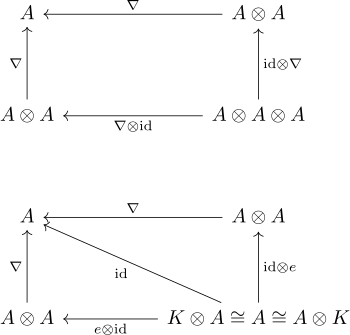
Notably this language allows us to give an alternate description of an (associative, unital) algebra through two commutative diagrams:
Commutative Diagrams (Algebra)

algebra.png

These diagrams describe the exact definitions listed above. The top diagram states the associativity and bilinearity (through the universal property of the tensor product!) of the product and the bottom diagram explains the role of the unit.

Coalgebras (Over Fields)

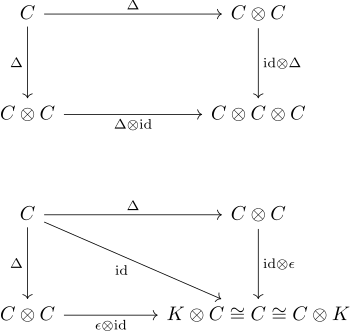
This categorical framing of an algebra as a vector space, product, and unit satisfying the above diagrams gives rise to a dual notion of a (coassociative, counital) coalgebra. This is a vector space C over a field K together with a coproduct Δ:CCC and a counit ϵ:CK that satisfy the following dual commutative diagrams.
Commutative Diagrams (Coalgebra)

coalgebra.png

Before discussing bialgebras, it will be useful to briefly define the natural (co)algebra structures that exist on the tensor product of a (co)algebra with itself.

Note

Let (A,,e) be an algebra and τ:AAAA a map defined by τ(ab)=ba.

Define

2:(AA)(AA)AA2=()(idτid)

and

e2:KKKAAe2=ee.

Then (AA,2,e2) is an algebra.

Similarly for a coalgebra (C,Δ,ϵ). We define

Δ2:CC(CC)(CC)Δ2=(idτid)(ΔΔ)

and

ϵ2:CCKKKϵ2=ϵϵ.

Then (CC,Δ2,ϵ2) is a coalgebra.

This all likely seems pretty straightforward besides maybe the role of the τ map. It is easy to see why this map shows up if you consider the natural product structure on AA. For two elements ab and cd, the standard product between them ought to be component-wise (i.e. 2((ab)(cd))=acbd). However, if we define naively 2= then 2((ab)(cd))=abcd. The twist map is then a simple way to define 2 compatible with our standard notion of component-wise multiplication.

Bialgebras

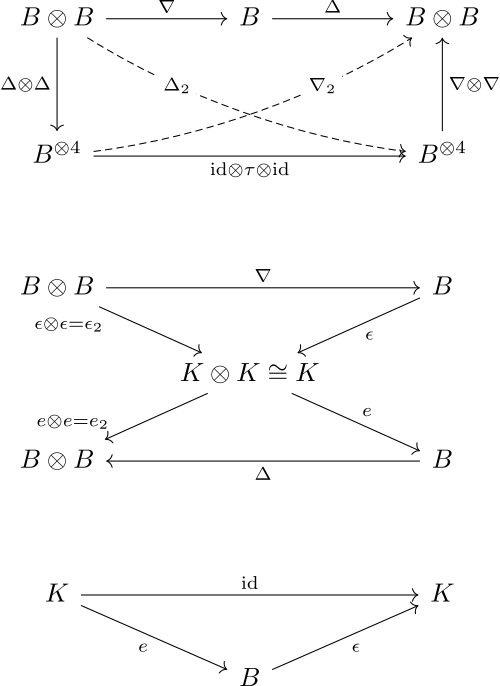
If a vector space B over K has both an (associative, unital) algebra and a (coassociative, counital) coalgebra structure, we call (B,,e,Δ,ϵ) a bialgebra so long as it satisfies the compatibility conditions characterized by the following commutative diagrams.

Commutative Diagrams (Bialgebra)

bialgebra.png

These look relatively abstract at first glance, but they are really just statements of (co)algebra homomorphism properties for the maps ,e,Δ, and ϵ. This is exactly why each diagram contains two dual subdiagrams (the third being self-dual).

The first and second diagram taken together state that the coproduct Δ:(B,,e)(BB,2,e2) is an algebra homomorphism. From the duals, the product :(BB,Δ2,ϵ2)(B,Δ,ϵ) is a coalgebra homomorphism.

The second and third diagram state that the counit ϵ:(B,,e)K is an algebra homomorphism. From the duals, the unit e:K(B,Δ,ϵ) is a coalgebra homomorphism.

Convolution Algebra

Let (B,,e,Δ,ϵ) be a bialgebra over K. Since B is a vector space, so too is HomK(B,B). We define a (bilinear, associative) product called the convolution product

:HomK(B,B)×HomK(B,B)HomK(B,B)

by

fg=(fg)Δ.

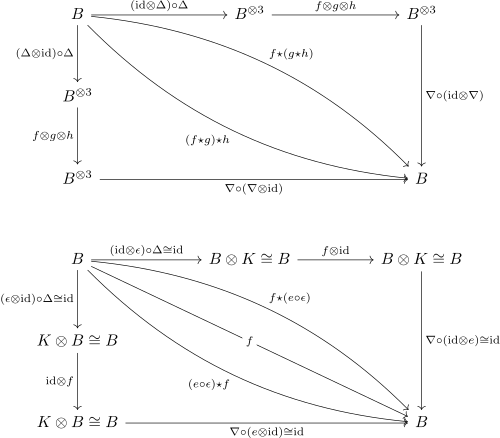
This product, together with the unit eϵ, makes (HomK(B,B),,eϵ) an (associative, unital) algebra. This can be shown by composing the (co)algebra diagrams for (B,,e,Δ,ϵ) in the way shown below. We call this the convolution algebra of B.

Commutative Diagrams (Convolution Algebra)

convolution.png

Antipode

Given a bialgebra (B,,e,Δ,ϵ) (and its associated convolution algebra), we can ask if the identity map id:BB has a convolutive inverse. That is, does there exist a map κ:BB such that

κid=idκ=eϵ?

If this map exists, we call it the antipode of B.

Hopf Algebra

We call a bialgebra with antipode (H,,e,Δ,ϵ,κ) a Hopf algebra.

Every tensor algebra admits a Hopf algebra structure, and understanding some properties of the Hopf algebra will be useful in describing the key algebraic properties of the path signature.

Firstly, the existence of the antipode will allow us to define a subset of our bialgebra which is a group under the bialgebra product. We call elements of this subset group-like elements.

Group-Like Elements

Let (H,,e,Δ,ϵ,κ) be a Hopf algebra. We call an element hH group-like if h0 and

Δ(h)=hh.

Then G(H)={hH:h0,Δ(h)=hh} are the group-like elements of H and (G(H),) is a group.

Group-Like Elements Form a Group

Let (H,,e,Δ,ϵ,κ) be a Hopf algebra and G(H) its collection of group-like elements.


Let a,bG(H). Then, by the compatibility axioms of the bialgebra, we have

Δ((ab))=(()(idτid)(ΔΔ))(ab)=(()(idτid))((aa)(bb))=()((ab)(ab))=(ab)(ab).

So G(H) is closed under .


Since G(H)H and is associative on H by definition of H as an algebra, is associative on G(H).


By compatibility axioms of the bialgebra,

Δe=ee.

This immediately yields Δ(1)=11. Therefore 1G(H) and, by the same logic as above, 1 is an identity with respect to on G(H).


For any bG(H),

(bκ(b))=((idκ))(bb)=((idκ)Δ)(b)=(idκ)(b)=(eϵ)(b).

Similarly,

(κ(b)b)=((κid))(bb)=((κid)Δ)(b)=(κid)(b)=(eϵ)(b).

Now note that the definition of the counit implies

((idϵ)Δ)(b)=b.

Therefore we have that bϵ(b)=b and, by the scalar multiplication identification BKB, we have ϵ(b)b=b. Thus, ϵ(b)=1K.
Then,

(eϵ)(b)=e(1K)=1.

So we have shown that for every bG(H),

b1=κ(b).

Further, by the bialgebra compatibility axioms and the above inverse property,

(Δ)(bκ(b))=2((bb)Δ(κ(b)))

and

(Δ)(bκ(b))=11.

Therefore, by applying the multiplication 2(κ(b)κ(b)) to both sides, we have

κ(b)κ(b)=2[(κ(b)κ(b))2((bb)Δ(κ(b)))].

By the associativity of 2,

κ(b)κ(b)=2[2((κ(b)κ(b))(bb))Δ(κ(b))]=2[(11)Δ(κ(b))].

Therefore,

κ(b)κ(b)=Δ(κ(b)).

That is, κ(b)G(H).


Therefore (G(H),) is a group with inverses given by κ.

There is a second set of interesting elements of a Hopf algebra: the primitive elements. These elements form a Lie algebra under the standard commutator bracket. We will briefly give a definition of a Lie algebra before moving forward.

Lie Algebra

Let g be a vector space over the field K and let [,]:ggg be a bilinear (not generally associative) binary operation satisfying the following two properties:

[aa]=0

for every ag, and

[a[bc]]+[c[ab]]+[b[ca]]=0

for every a,b,cg.
Then (g,[,]) is called a Lie algebra and [,] a Lie bracket.

Primitive Elements

Let (H,,e,Δ,ϵ,κ) be a Hopf algebra. We call an element hH primitive if

Δ(h)=h1+1h.

Then P(H)={hH:Δ(h)=h1+1h} are the primitive elements of H.


Let [,]:HHH be defined by

[ab]=(ab)(ba).

Then (P(H),[,]) is a Lie algebra.

Primitive Elements Form a Lie Algebra

Let (H,,e,Δ,ϵ,κ) be a Hopf algebra and let P(H) denote its primitive elements. Let [,] be the Lie bracket map defined above.


Firstly, note that 0P(H) since

Δ(0)=0=01+10.

Secondly, the linearity of Δ means that for a,bP(H) and k1,k2K, we have

Δ(k1a+k2b)=k1Δ(a)+k2Δ(b)=(k1a1+1k1a)+(k2b1+1k2b).

So, k1a+k2bP(H) and therefore P(H) is a vector subspace of H.


For a,bP(H), we have:

Δ([ab])=Δ((ab)(ba))=(Δ)(ab)(Δ)(ba).

Then from our bialgebra compatibility axioms:

=2((a1+1a)(b1+1b))2((b1+1b)(a1+1a))=(ab)1+ab+ba+1(ab)(ba)1baab1(ba)=((ab)(ba))1+1((ab)(ba))=[ab]1+1[ab]

Therefore [ab]P(H) and so (P(H),[,]) is an algebra over K.


The two Lie bracket properties follow immediately from the definition of [,] with only brief calculations. Therefore, we omit the details and state that [,] is a Lie bracket.


Thus, (P(H),[,]) is a Lie algebra.